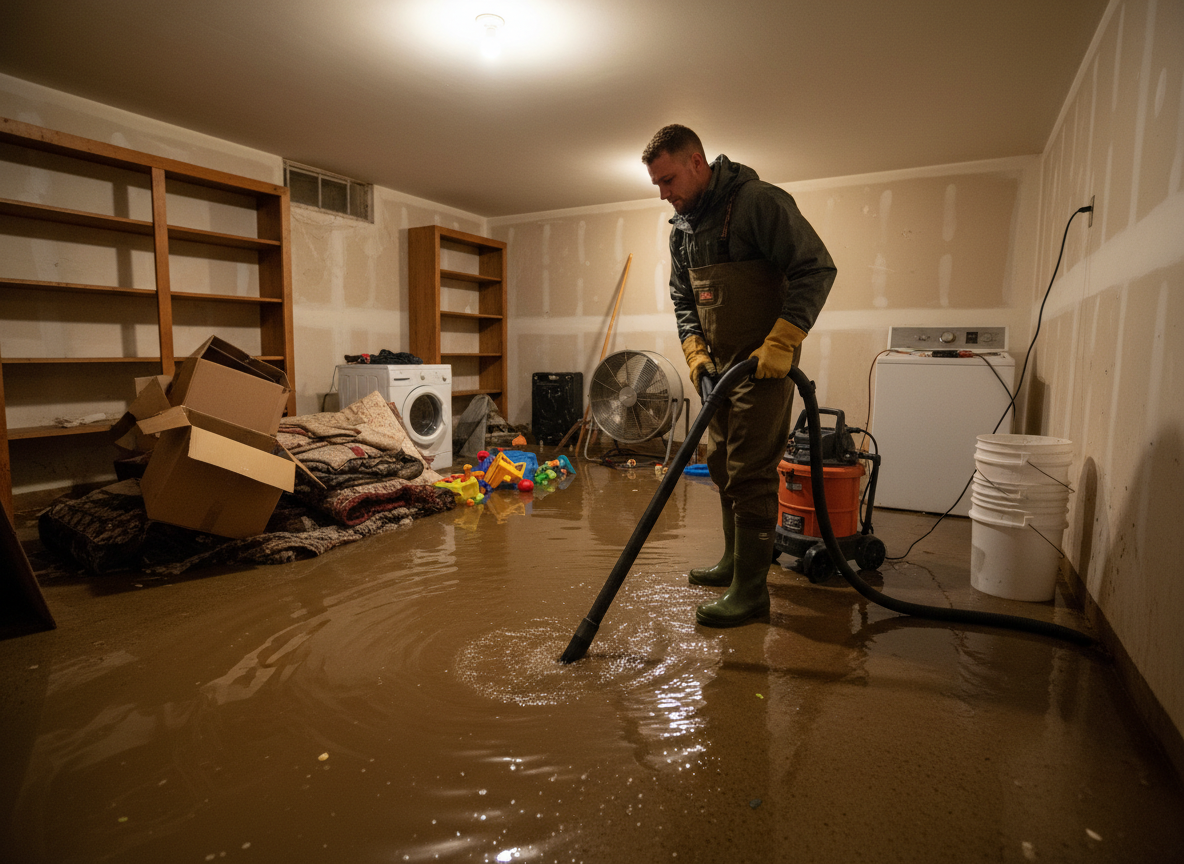
Sugarloaf sits at elevation in the San Bernardino Mountains where winter snow accumulation on roofs and ground often leads to spring meltwater finding paths into basements. Older cabin-style homes here typically feature concrete block or poured foundations that develop hairline cracks over decades of freeze-thaw cycles. When floodwater enters, it quickly saturates insulation behind finished walls and collects under slab-on-grade sections common in Running Springs and Big Bear Lake spillover properties. Technicians must map moisture with thermal imaging because visible puddles disappear fast once temperatures drop below freezing again.
Removal begins with submersible pumps rated for cold water to avoid equipment failure, followed by air movers and dehumidifiers calibrated for the dry mountain air that can pull moisture unevenly. Edge cases include hidden water trapped between joists when homes sit on sloped lots facing the national forest, where soil stays saturated longer than valley areas. Homeowners sometimes attempt DIY drying with household fans, which fails to reach behind baseboards and creates hidden mold colonies that only appear during the next warm spell. Proper documentation of affected materials helps when insurance adjusters visit properties accessed via narrow forest roads.
San Bernardino County building practices require vapor barriers in new basements, yet many Sugarloaf structures predate those rules and rely on older perimeter drains that clog with pine needles and sediment. Cleanup crews check these drains first because blocked lines turn minor seepage into standing water that reaches electrical outlets and HVAC returns. After extraction, antimicrobial treatments focus on porous materials like particleboard shelving rather than blanket spraying, since cold winters slow mold growth but do not eliminate spores once temperatures rise above 50 degrees.
Technician insight
In Sugarloaf, the thing that catches most people out with Basement flood cleanup is how snow melt from the San Bernardino National Forest side of the property travels under the slab and refreezes overnight, pushing water into finished walls that homeowners never see until spring.
Spring Melt Seepage Near the Forest
Rapid snow melt around a Sugarloaf cabin sent water under the foundation and into the finished basement. We found moisture trapped behind paneling and under carpet pad that had already begun to affect subflooring. Extraction and targeted drying prevented further spread into adjacent rooms. The basement was returned to dry standards within four days.
How it works
- 1
On-Site Assessment
Technicians arrive within hours, inspect for hidden moisture using meters and thermal cameras, and note foundation cracks common in Sugarloaf's freeze-thaw climate.
- 2
Water Extraction
Submersible pumps and wet vacuums remove standing water while protecting electrical systems in older mountain homes near the national forest.
- 3
Drying and Monitoring
Industrial air movers and dehumidifiers run until moisture readings stabilize, with daily checks to account for cold nights that slow evaporation.
- 4
Material Removal and Sanitation
Saturated drywall, insulation, and flooring are removed, followed by targeted cleaning of remaining surfaces to prevent mold during warm summer months.
- 5
Final Verification
Post-drying moisture mapping confirms all areas are dry before reconstruction recommendations are provided to the homeowner.
Pricing
Pricing varies with water volume, access difficulty on sloped mountain lots, and the number of days required to reach dry standards in cold weather.