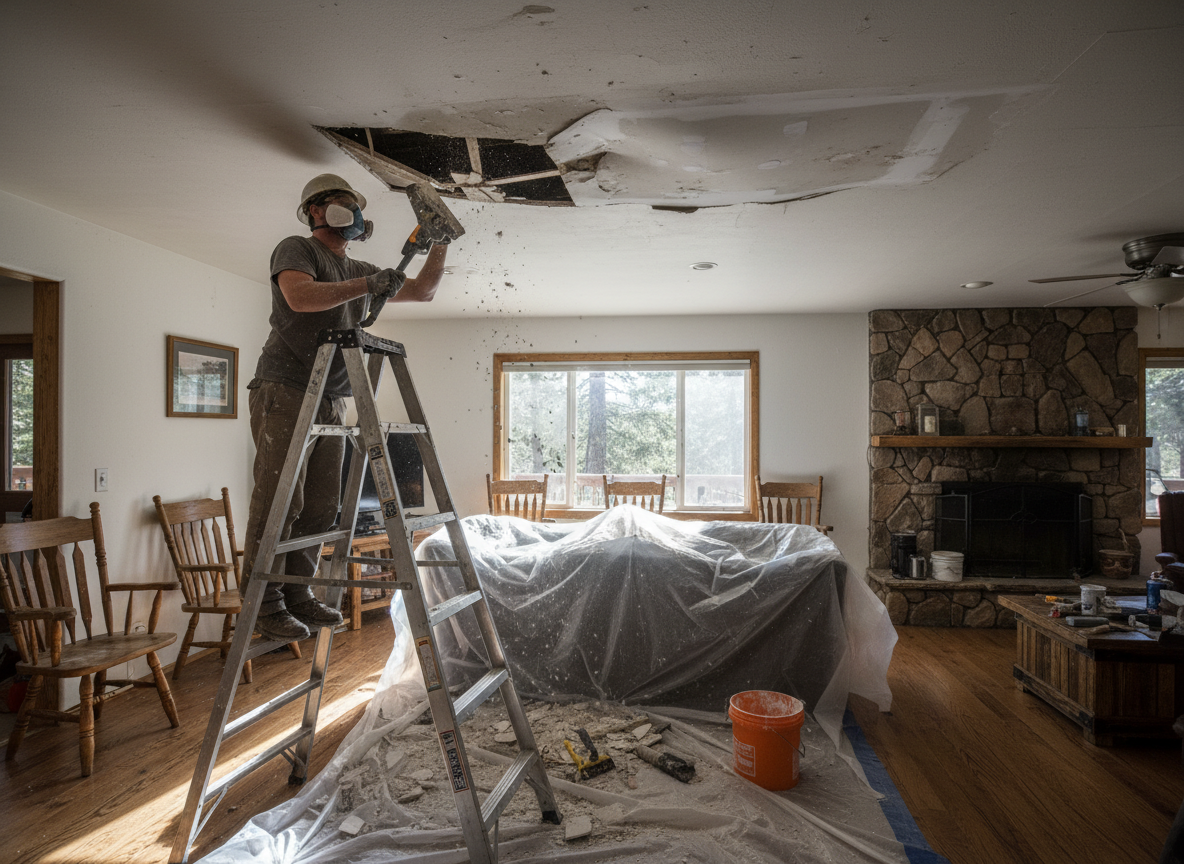
In Sugarloaf, ceiling water damage often starts from roof penetrations strained by heavy winter snow loads and freeze-thaw cycles common in the San Bernardino Mountains. Older cabin-style homes near the San Bernardino National Forest frequently have layered roofing and limited attic access, allowing moisture to travel along ceiling joists before visible staining appears. Technicians must remove sections of drywall while preserving structural integrity, then dry cavities with targeted airflow because standard dehumidifiers alone cannot reach trapped water between insulation and sheathing. Ignoring the slope of the terrain around Running Springs properties can let meltwater re-enter through foundation transitions, turning a single leak into repeated ceiling failures.
Inspection begins with thermal imaging to map moisture behind textured ceilings without unnecessary demolition. Once the source is isolated, affected materials are cut out in controlled sections to limit dust in tight mountain homes. Antimicrobial treatment follows to address mold risk amplified by the area's cool, humid winters. Replacement uses moisture-resistant drywall matched to existing finishes, then texture and paint are blended on site. Final verification with moisture meters confirms readings below 12 percent before any surface is closed, preventing callbacks during the next snow event.
Homeowners in Sugarloaf sometimes attempt ceiling patches without tracing the leak path, especially after summer thunderstorms that saturate aging asphalt shingles. This leaves saturated insulation in place, which later sags and promotes hidden mold growth. Proper repair requires access through attic spaces common in local A-frame and ranch homes, followed by verification that all wet material has been removed. Because many properties sit on sloped lots facing the national forest, drainage around the structure must also be checked to stop water from wicking upward into wall cavities connected to the ceiling.
Technician insight
In Sugarloaf, the thing that catches most people out with Ceiling water damage repair is how quickly snow melt from the San Bernardino National Forest side of the roof travels along ceiling joists in older cabins before any stain shows up downstairs. Homeowners patch the ceiling and think they're done, but the insulation stays wet through the next freeze cycle and mold takes hold. You have to pull enough material to reach dry wood every time.
Winter Roof Leak into Living Room Ceiling
Heavy snow followed by a warm spell sent meltwater under lifted shingles on a Sugarloaf cabin near the national forest boundary. Water tracked along ceiling joists and soaked insulation above the main room. We mapped the moisture, removed the wet sections, dried the cavity, and replaced the ceiling with matching texture. No further staining appeared after the next snow.
How it works
- 1
Initial Assessment
Technician arrives within hours, uses moisture meters and thermal imaging to locate the full extent of ceiling saturation without guesswork.
- 2
Source Isolation and Containment
Roof or plumbing leak is stopped, then plastic barriers are set up to protect unaffected areas of the Sugarloaf home.
- 3
Drying and Material Removal
Wet drywall and insulation are removed, followed by directed drying equipment run until readings drop below safe thresholds.
- 4
Repair and Finish
New moisture-resistant materials are installed, textured, and painted to match surrounding ceilings.
Pricing
Pricing varies by extent of hidden damage and access difficulty; upfront quotes follow inspection.