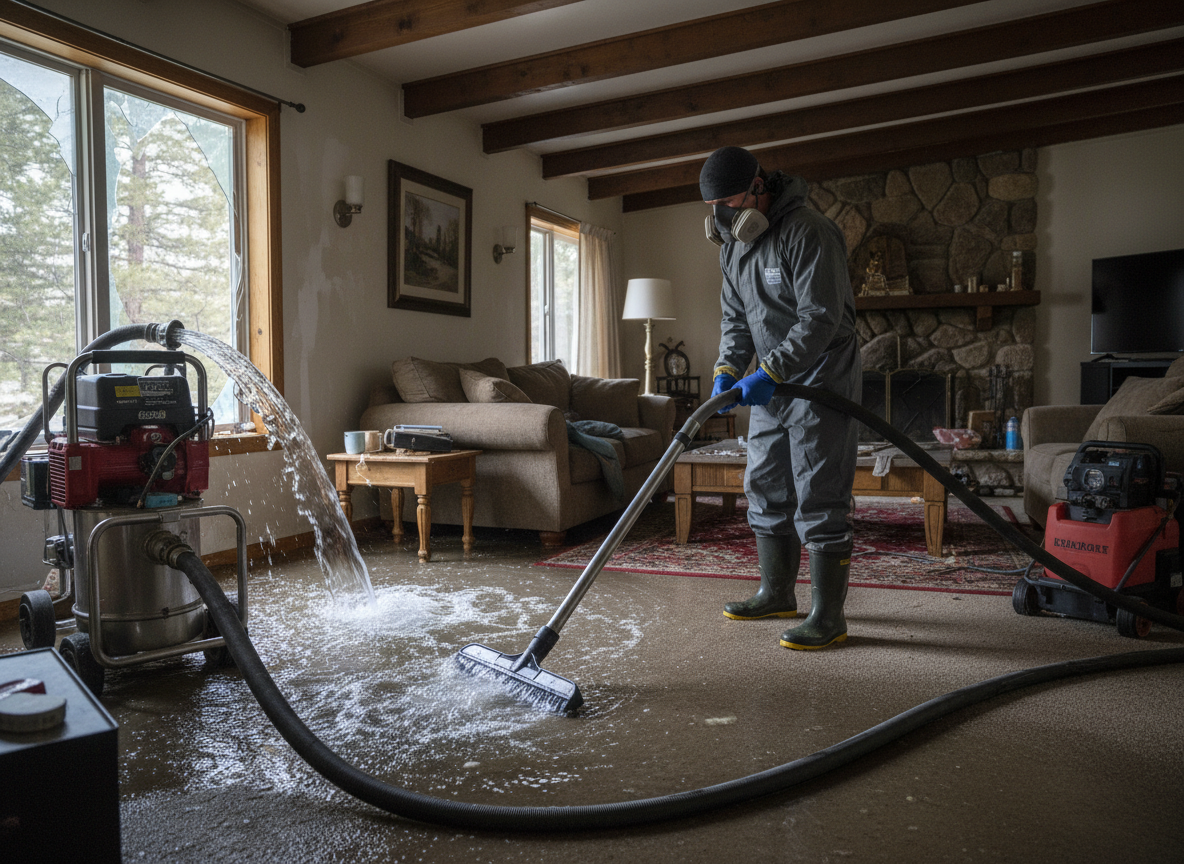
Sugarloaf sits at elevation in San Bernardino County where winter snowpack melts into crawl spaces and basements of older cabins built before modern grading standards. Rapid water extraction must account for frozen ground that slows drainage and forces water to pool against foundations near the San Bernardino National Forest boundary. Technicians use truck-mounted pumps with high-volume hoses to pull water before it migrates into wall cavities or subfloors common in 1960s-1980s construction along Maple Lane and nearby ridges.
Edge cases appear after heavy spring runoff when water from Running Springs and Big Bear Lake watersheds saturates soil and backs up through floor drains. Extraction crews check for hidden voids under decks and in utility rooms where pine needle debris clogs French drains. Equipment must handle both cold water that refreezes overnight and warmer summer monsoon flows that carry sediment from forest slopes.
Homeowners often attempt shop-vac removal first, which leaves moisture trapped in particleboard subfloors typical of local builds. Professional extraction includes moisture mapping with infrared cameras to locate water that has wicked into insulation or under vinyl flooring installed over concrete slabs on grade. Delaying extraction past 24 hours increases the risk of mold in the humid microclimates created by dense tree cover.
Seasonal Guidance
Mountain winters bring repeated freeze-thaw cycles that crack foundations and allow snowmelt to enter repeatedly. Summer thunderstorms can drop inches in hours on already saturated ground around Sugarloaf, requiring immediate high-capacity extraction to protect electrical systems in lower-level rooms.
Technician insight
In Sugarloaf, the thing that catches most people out with Rapid water extraction is how quickly snowmelt from the San Bernardino National Forest re-enters crawl spaces of older cabins along Maple Lane once the sun hits the south slopes. Homeowners clear the visible puddle but miss the water that has wicked under the subfloor because the ground stays frozen longer at elevation.
Spring Snowmelt Entry
A cabin near the forest edge took on several inches of water through the crawl space after a rapid melt. Crews found the water had traveled under the living room floor because the lot sloped toward the foundation. High-volume pumps cleared the standing water in one visit while infrared confirmed no migration into wall plates. Follow-up drying prevented cupping of the original hardwood.
How it works
- 1
On-Site Assessment
Technician arrives within hours, maps water depth and sources while noting terrain slope and proximity to forest drainage paths.
- 2
Water Removal
High-volume pumps extract standing water from floors and crawl spaces, routing discharge away from neighboring properties on narrow mountain roads.
- 3
Moisture Verification
Infrared and pin meters confirm removal from wood framing and insulation before air movers are placed.
- 4
Documentation
Photos and readings are recorded for insurance and to guide any follow-up drying work in cold weather conditions.
Pricing
Pricing varies with water volume, access difficulty on steep lots, and whether extraction occurs during winter snow conditions.